
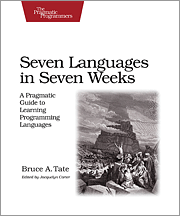
 It is the end of the first “week” with the book. Due to very busy pre holidays period and holidays it actually took me a month to get through it. I hope things will be less hectic in coming weeks so that I can live up to the book’s title.
So week one with Ruby then. Everyone interested in software development has almost certainly come across this language. It has captured the interest of disgruntled masses with very productive Rails framework back in 2005. I remember seeing the infamous blog demo videocast and being blown away by the fact that this guy seems to be able to knock up a blog from scratch in about 15 minutes. What I was even more impressed with was how clean and sensible the code he was writing was. I tinkered around with Ruby for a little bit back then, but I got pulled more deeply into the world of Java at that time, as as this was lingua franca in company where I worked and the idea was that it was more important for me to master that than a side language.
So what did I miss out on by doing that? For one Ruby is a pure Object Oriented programming language which means that everything including literals is an object. It uses strong and dynamic (duck) typing strategies. This allows for polymorphism by functionality rather then by declared types; which gives you more freedom and less typing at the expense of compile time type checking. All the classes in Ruby are open and can be extended, including classes such as String and NilClass. It supports mixins (think interfaces with implementation) as a workaround for multiple inheritance. Provided APIs are rich and frequently provide same functionality via different methods. Ruby and it’s APIs rely on code blocks (closures, higher order functions – how ever you want to call them) heavily. It also provides good metaprogramming facilities. All of this makes it a wonderful and expressive language, but at the same time it gives you all the rope you want to hang yourself. Read on »
 I am Dalibor "Bore" Novak, a software developer working with Java. My passion lies in code craftsmanship, agile methodologies, open source movement and new interesting technologies.